

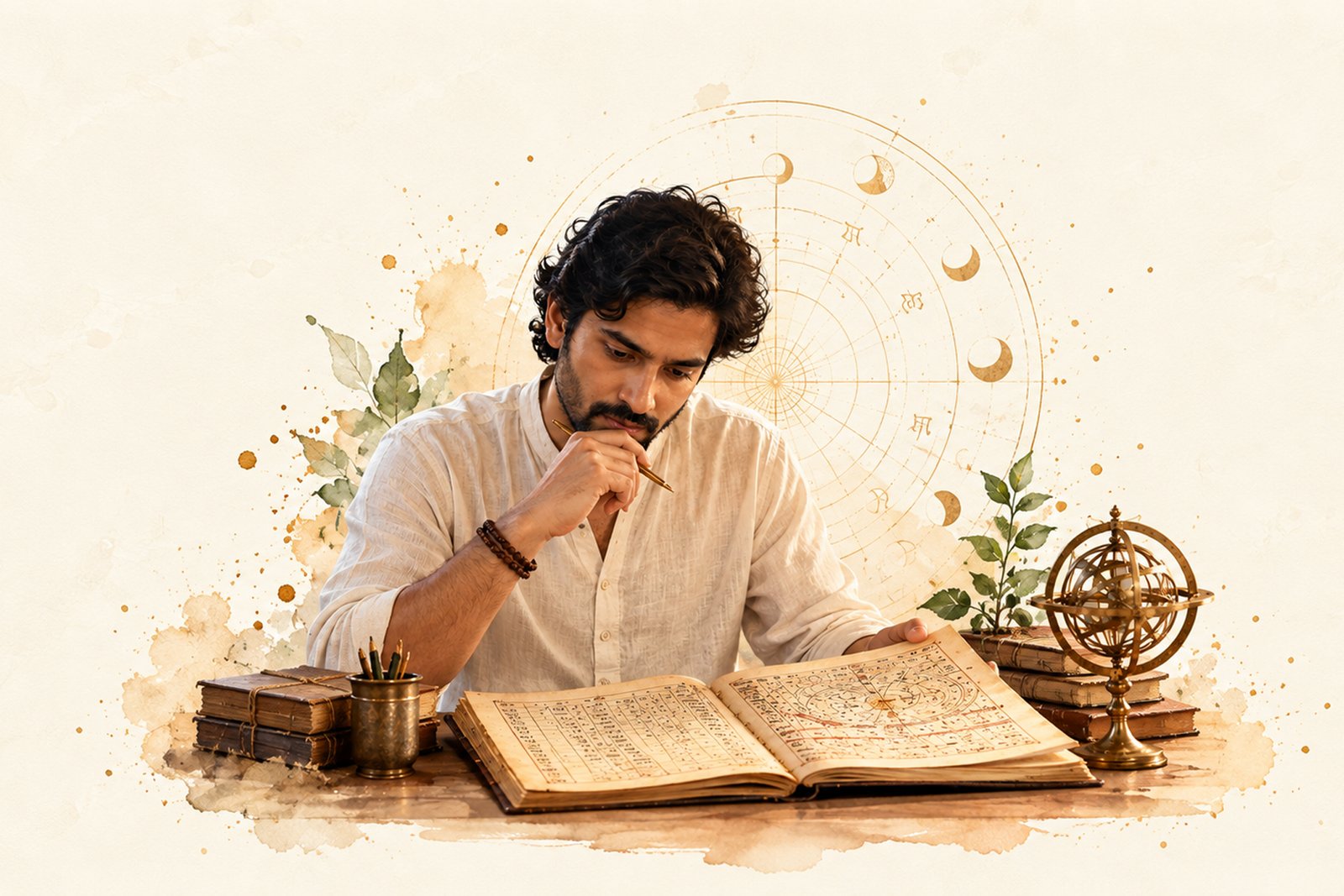
Understanding Time, Patterns, and Possibility
Jyotisha is the traditional Indian study of time, celestial movements, and their relationship with life on Earth.
The word Jyotisha comes from the Sanskrit root jyoti, meaning light. Traditionally, Jyotisha is concerned with understanding the patterns of time through the movements of the Sun, Moon, planets, and other celestial bodies.
At Tattva Bodha, we approach Jyotisha as a traditional knowledge system that invites observation, reflection, and a deeper understanding of time and life.
It is not simply about predicting the future. It is about learning to observe patterns, cycles, tendencies, and the conditions in which life unfolds.
From the Sky to the Cycles of Life
Human life moves through cycles.
Day and night, lunar phases, seasons, planetary movements, and larger cycles of time have always influenced how traditional Indian cultures understood life and its rhythms.
Jyotisha provides a framework for studying these cycles.
Through careful observation of the celestial order, it explores questions such as:
What is the nature of this particular time?
What patterns are present?
How do different cycles interact?
How can we understand our tendencies and circumstances more clearly?
The purpose is not to create fear about what may happen, but to cultivate awareness of the patterns through which life unfolds.
The Foundations of Jyotisha
Jyotisha is a broad field with several interconnected areas of study.
Panchanga
Panchanga is the traditional Indian calendar system.
The word Panchanga means “five limbs” and refers to five important elements used to understand the quality of a particular day:
Tithi — the lunar day
Vara — the weekday
Nakshatra — the lunar constellation
Yoga — a particular Sun–Moon relationship
Karana — half of a lunar day
Together, these provide a traditional way of observing and understanding time.
Graha
The Navagraha, or nine celestial influences, form an important part of Jyotisha.
They include the Sun, Moon, Mars, Mercury, Jupiter, Venus, Saturn, and the lunar nodes Rahu and Ketu.
In Jyotisha, these are studied not merely as physical objects in space, but as symbolic and astronomical components within a larger framework of time and experience.
Rashi
Rashi refers to the twelve divisions of the zodiac.
The zodiac provides a framework through which planetary positions are observed and interpreted.
Each Rashi forms part of the larger astronomical and symbolic structure used in Jyotisha.
Nakshatra
The Nakshatras are twenty-seven divisions of the lunar path.
Because the Moon moves relatively quickly through the zodiac, its position among the Nakshatras provides a detailed way of observing time and patterns.
Nakshatra study adds another layer of depth to the traditional understanding of the horoscope.
Kundali
A Kundali, or birth chart, is a representation of the celestial positions at a particular moment and location.
Traditionally, it is used as a framework for studying tendencies, relationships between planetary positions, and cycles of time.
At Tattva Bodha, we approach the Kundali as a tool for reflection and understanding rather than as a source of absolute certainty.
Time and Karma
One of the deeper ideas explored through Jyotisha is the relationship between time and karma.
Karma can be understood broadly as action and its consequences.
Jyotisha does not need to be approached as a system that removes human choice.
Instead, it can be studied as a way of understanding the conditions and tendencies within which choices are made.
Awareness of a pattern does not necessarily determine an outcome.
It can create space to respond to that pattern consciously.
Jyotisha and Everyday Life
The value of Jyotisha can extend beyond horoscope interpretation.
It can encourage us to become more attentive to time itself.
When is the right moment to begin?
When is patience more appropriate?
What patterns keep repeating?
What can we learn from the cycles of our own lives?
These questions bring Jyotisha into a practical relationship with everyday awareness.
What You’ll Explore
Foundations of Jyotisha
The meaning and purpose of Jyotisha within the Indian knowledge tradition.
Understanding the Panchanga
Learn the five limbs of the traditional Indian calendar and how they describe the qualities of time.
Graha and Their Significance
Explore the Navagraha and their place within the traditional Jyotisha framework.
Rashi and Nakshatra
Understand the twelve Rashis and twenty-seven Nakshatras and their role in reading celestial patterns.
Understanding the Kundali
Learn how a traditional birth chart is constructed and how its different elements are understood.
Time, Cycles, and Dasha
Explore traditional approaches to planetary periods and the unfolding of cycles through time.
Jyotisha as Reflection
Learn to approach Jyotisha with curiosity, observation, and discernment rather than fear or fatalism.
Your Study Begins With Observation
Jyotisha begins with looking upward and learning to observe.
The sky provides a vast clock of cycles and movements.
The deeper invitation is to notice how we relate to time, circumstance, choice, and change.
Study the patterns.
Understand the cycles.
Observe your life.
And gradually develop a clearer relationship with time.
Explore Jyotisha